Hydrazine is used notably as a synthesis intermediate in the chemical, pharmaceutical and agrochemical industries, as a laboratory reagent and as a fuel for space propulsion.
At room temperature, anhydrous hydrazine is a colourless, hygroscopic liquid with an ammonia-like odour. It is also supplied as a hydrate or in aqueous solutions, whose properties differ from those of the anhydrous substance.
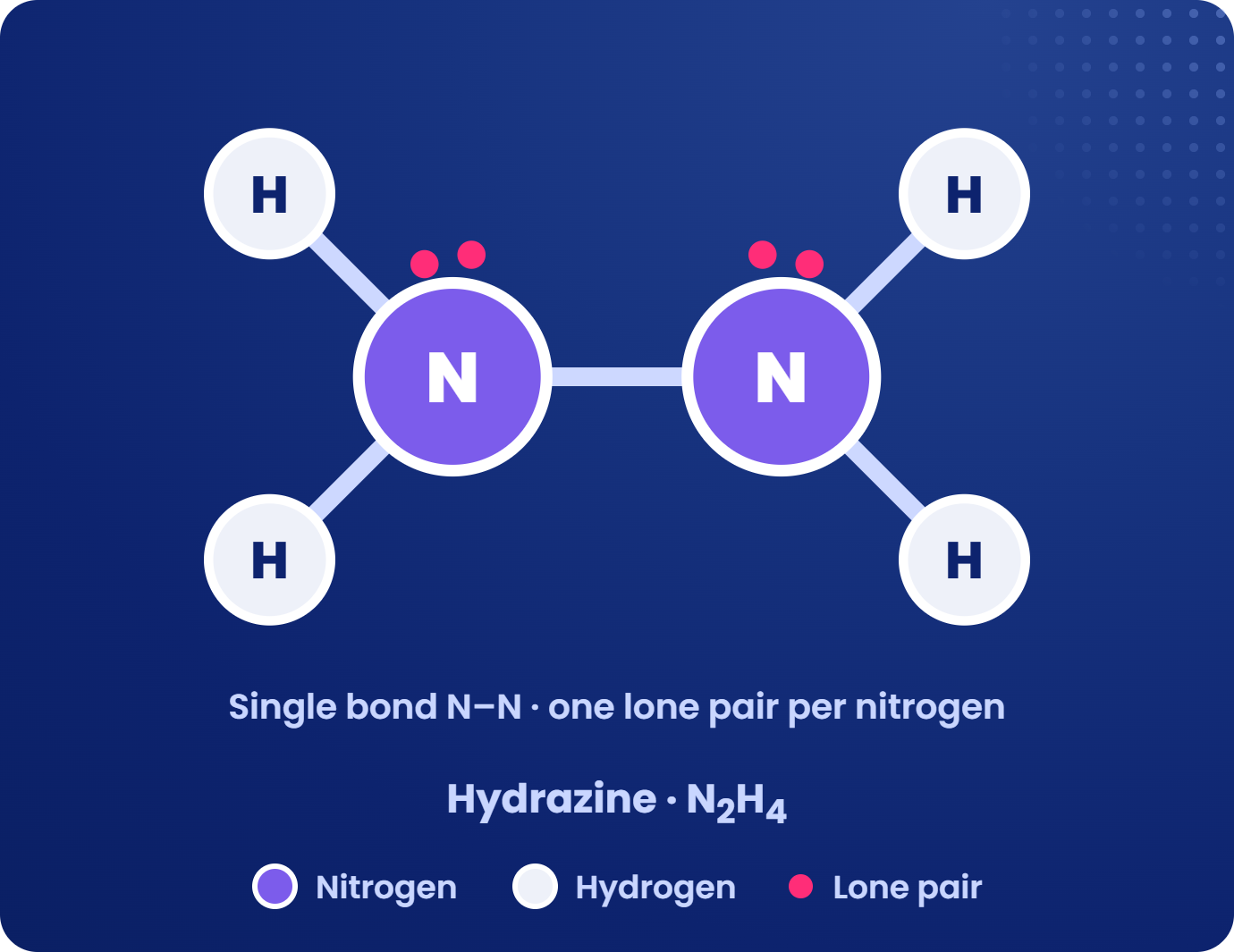
1Main properties
These values apply to anhydrous hydrazine. Hydrazine hydrate has a separate CAS number, 7803-57-8, and must not be confused with the anhydrous substance.
2What are the hazards?
Hydrazine is toxic if inhaled, in contact with skin or swallowed. It causes severe skin burns and serious eye damage, and may cause an allergic skin reaction.
It also carries the hazard statement “May cause cancer”. The carcinogenic risk must be included in the risk assessment and preventive measures.
Its liquid and vapours are flammable. It is also very toxic to aquatic life with long-lasting effects: releases into the environment must be prevented.
3What occupational exposure limits apply?
The INRS factsheet, updated in July 2025, reports the following binding regulatory occupational exposure limit established in France in 2021:
| Reference period | ppm | mg/m³ |
|---|---|---|
| 8-hour average | 0.01 | 0.013 |
| Short-term | Not specified in this factsheet | Not specified in this factsheet |
The skin notation indicates that skin absorption may contribute significantly to overall exposure.
This average limit does not, on its own, constitute a gas detector alarm setting. Air monitoring does not replace prevention of skin contact.
4How can risks be prevented?
Prevention relies on closed systems wherever possible, capturing vapours at source and providing suitable ventilation. The number of exposed workers must be reduced and atmospheric exposure monitored.
Keep ignition sources away and prevent electrostatic discharges through suitable earthing and equipotential bonding.
Procedures must prevent inhalation of vapours or aerosols and contact with skin or eyes. Operators must be trained in the substance’s hazards and emergency measures.