Hydrogen peroxide is used notably as a bleaching, disinfecting and oxidising agent. It is commonly supplied as an aqueous solution.
At room temperature, it is a colourless liquid that is miscible with water. It is generally marketed in stabilised aqueous solutions. Concentration strongly influences its properties and hazards: a dilute solution must not be treated as equivalent to a concentrated product.
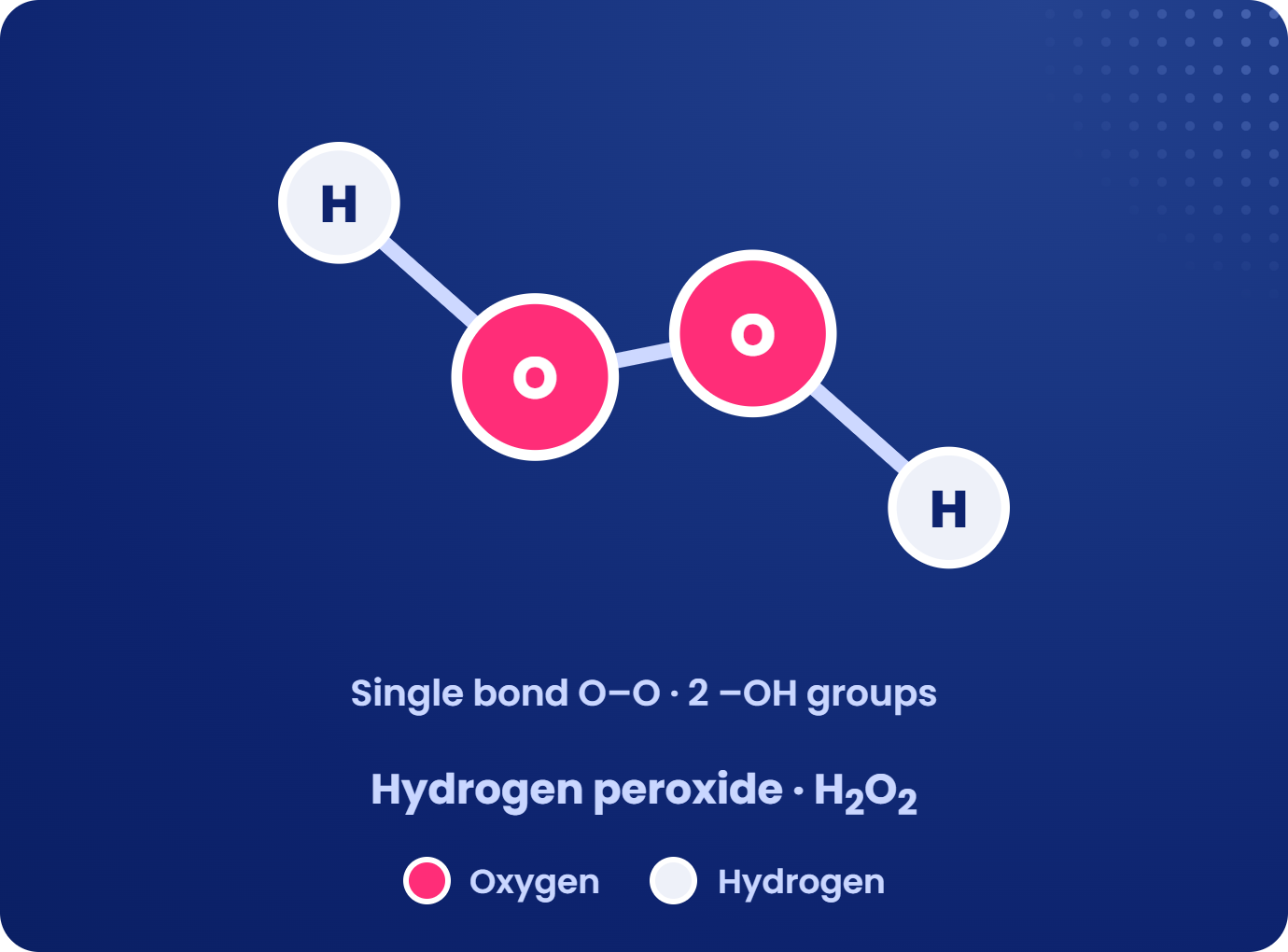
1Main properties
Values must always be associated with the corresponding concentration. Decomposition can also make determining the substance’s physical properties more difficult.
2What are the hazards?
Effects on the skin and eyes depend on concentration. Concentrated solutions can cause severe burns and serious eye damage. Exposure to vapours and mists must also be prevented.
Hydrogen peroxide is a powerful oxidising agent. Concentrated solutions can react violently with organic materials and ignite combustible substances.
Its decomposition releases oxygen and heat. Contamination, heating or certain metals can accelerate this process. In an unsuitable container, gas generation can cause dangerous pressure build-up.
3What occupational exposure limits apply?
The INRS factsheet dated January 2022 reports the following indicative occupational exposure limit established in France in 1987:
| Reference period | ppm | mg/m³ |
|---|---|---|
| 8-hour average | 1 | 1.5 |
| Short-term | Not specified in this factsheet | Not specified in this factsheet |
This value concerns the airborne concentration, rather than the concentration of the solution being used. It does not, on its own, constitute a gas detector alarm setting.
4How can risks be prevented?
Prevention relies on enclosed processes wherever possible, capturing emissions and providing suitable ventilation. Atmospheric exposure must be assessed regularly.
Prevent contamination of the product and use only equipment compatible with its concentration. Tanks must have suitable venting arrangements to release oxygen generated by any decomposition.
Gloves, protective clothing, eye protection and any respiratory protective equipment must be selected according to the risk assessment and safety data sheet.
Store in a cool, ventilated location, protected from heat, using containers specifically designed for the product. A rise in temperature or deformation of a container is an abnormal condition that must be addressed according to site procedures.