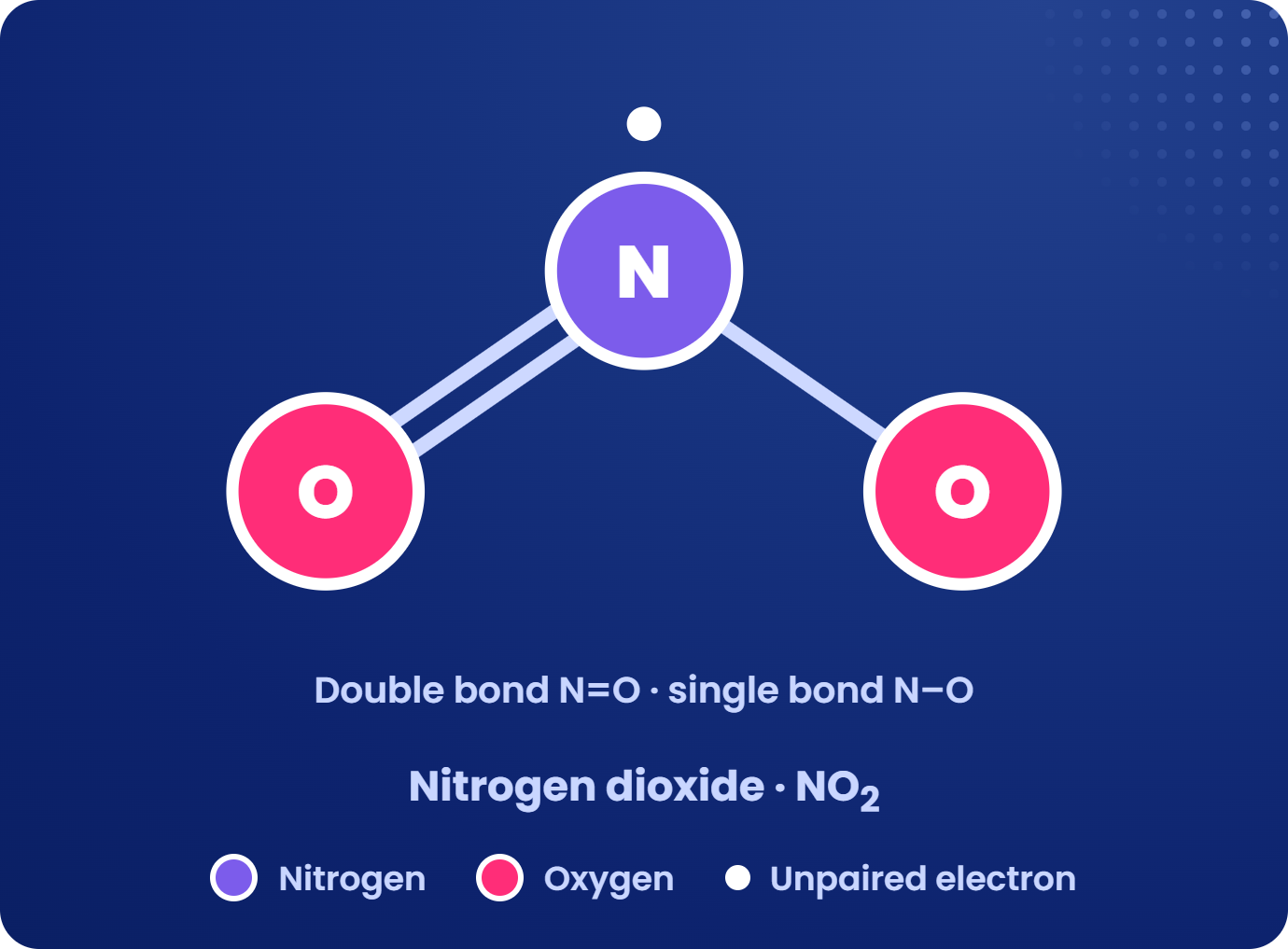
Nitrogen dioxide is used as an oxidising and nitrating agent in the chemical industry. It can also be present in combustion gases and released during welding, the use of explosives or operations involving nitric acid.
In its concentrated gaseous form, it has a reddish-brown colour and a strongly irritating odour. It exists in equilibrium with dinitrogen tetroxide, N₂O₄: the proportion of these two forms varies notably with temperature.
1Main properties
The phase transition temperatures apply to the NO₂/N₂O₄ equilibrium system. Nitrogen dioxide should therefore not be described as a pure molecular species independent of this equilibrium.
2What are the hazards?
Nitrogen dioxide is fatal if inhaled and corrosive. It can cause serious damage to the eyes, skin and respiratory tract.
Exposure may cause coughing, breathing difficulties and severe lung injuries. Pulmonary oedema can develop up to 48 hours after exposure. An initial improvement therefore does not rule out danger.
Nitrogen dioxide is not combustible, but it is an oxidising gas: it can cause or intensify a fire. It may react violently with combustible materials and reducing agents. In the presence of moisture, it is also highly corrosive to many metals.
3What occupational exposure limits apply?
The INRS occupational exposure limits database reports the following binding regulatory limits established in France in 2019:
| Reference period | ppm | mg/m³ |
|---|---|---|
| 8-hour average | 0.5 | 0.96 |
| Short-term, 15 minutes | 1 | 1.91 |
These occupational exposure limits do not, on their own, constitute gas detector alarm settings.
4How can risks be prevented?
Prevention relies on enclosed processes wherever possible, capturing emissions at source and providing suitable ventilation. Atmospheric exposure must be monitored regularly; a gas detection system with alarms can complement these measures.
Cylinders must be stored upright and secured, in a cool, well-ventilated area, protected from heat and separated from combustible gases and materials. Equipment materials must be compatible with the substance.
Personal protective equipment must be suitable for the working conditions. Self-contained breathing apparatus must be available for emergency response.
In the event of a leak, evacuate the area and follow emergency procedures. Accidental inhalation requires prompt medical attention because of the risk of delayed lung injury.
Sources: INRS, Toxicological Factsheet No. 133, “Nitrogen oxides”, July 2020 edition, in French; INRS occupational exposure limits database, “Nitrogen dioxide”, updated September 2022, in French.