Ozone, also known as trioxygen, is used notably for water treatment, equipment disinfection and paper pulp bleaching. It can also be generated unintentionally during arc welding or when using certain ultraviolet-emitting equipment.
At room temperature, it is a colourless or slightly bluish gas with a pungent odour. Olfactory adaptation occurs quickly, so its odour is not a reliable means of monitoring exposure.
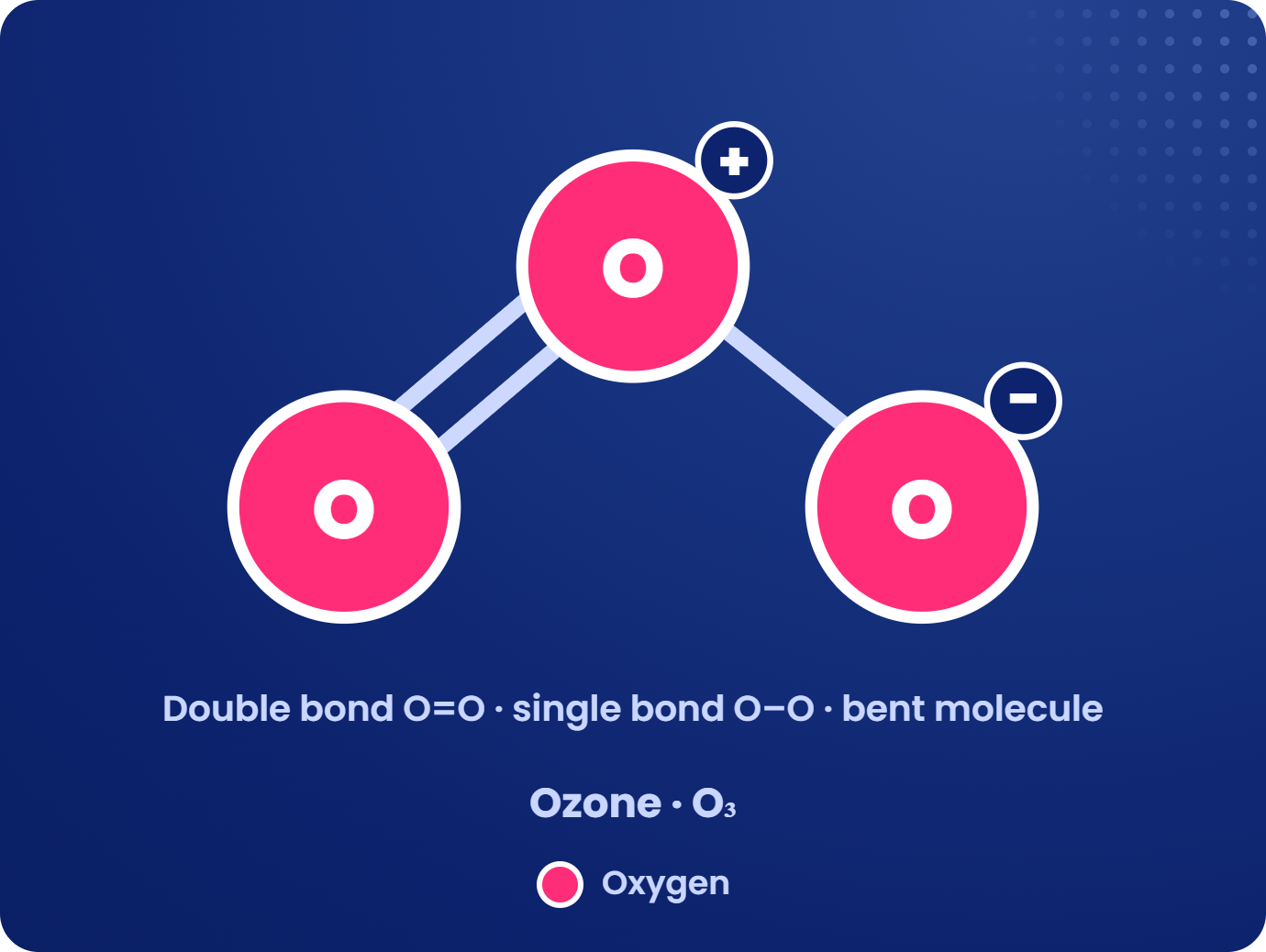
1Main properties
The decomposition rate depends notably on temperature, humidity and contact materials. No universal waiting period guarantees its disappearance from a room.
2What are the hazards?
Ozone is fatal if inhaled. The INRS factsheet updated in May 2026 also identifies risks of serious damage to the respiratory, nervous and cardiovascular systems.
Its harmonised labelling includes the hazard statements “Suspected of causing genetic defects” and “Suspected of causing cancer”. It also presents a significant hazard to aquatic life.
It is a powerful oxidising agent, capable of causing or intensifying a fire. It can react violently with combustible substances and reducing agents. In liquid or solid form, it is particularly unstable and may explode.
3What occupational exposure limits apply?
The INRS factsheet dated May 2026 reports the following non-regulatory guideline limits established in France through ministerial circulars in 1982:
| Reference period | ppm | mg/m³ |
|---|---|---|
| 8-hour average | 0.1 | 0.2 |
| Short-term, 15 minutes | 0.2 | 0.4 |
These limits do not, on their own, provide a complete alarm configuration. Reference periods, detector performance and the actions associated with alarms must be considered.
4How can risks be prevented?
Prevention relies on closed processes, capturing emissions and providing suitable ventilation. Because ozone is unstable, it is generated at the point of use, rather than stored.
Materials and seals must be compatible with ozone, and installations must be checked for leaks. INRS recommends an alarm system linked to automatic installation shutdown to prevent excessive exposure.
In the event of a leak, stop the generator if this can be done safely, evacuate the area and follow emergency procedures. Interventions require trained personnel and suitable protection; self-contained breathing apparatus must be available.
Sources: INRS, Toxicological Factsheet No. 43, “Ozone”, updated May 2026, in French; INRS occupational exposure limits database, “Ozone”, in French.