This factsheet concerns n-pentane, CAS number 109-66-0. The formula C₅H₁₂ also applies to other isomers, whose properties may differ.
At room temperature, n-pentane is a colourless, highly volatile and highly flammable liquid. Its vapours are heavier than air and can spread along the ground and accumulate in low-lying areas.
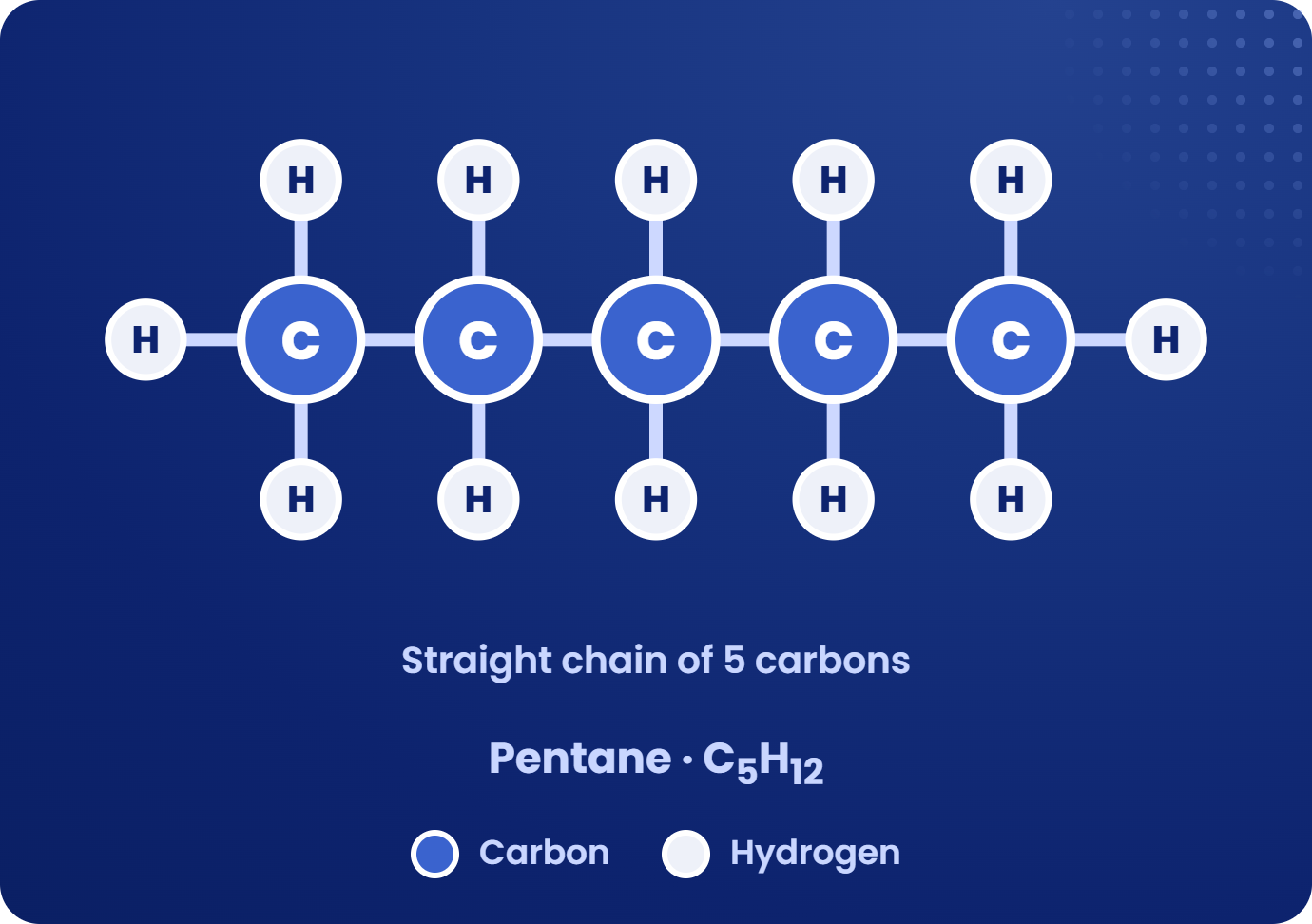
1Main properties
The CarAtex database lists a flash point below −40 °C, closed cup. These data apply to n-pentane and must not be applied indiscriminately to commercial mixtures.
2What are the hazards?
Pentane readily forms explosive mixtures with air. Its vapours can reach an ignition source some distance from the leak.
Inhaling high concentrations may cause central nervous system depression, with drowsiness, dizziness and unconsciousness. Repeated contact dries out the skin and may cause cracking.
Swallowing presents a pulmonary aspiration hazard: the liquid can enter the respiratory tract and cause potentially fatal chemical pneumonitis.
It is also incompatible with strong oxidising agents, including peroxides and perchlorates.
3What occupational exposure limits apply?
The INRS occupational exposure limits database reports the following binding regulatory occupational exposure limit established in France in 2007:
| Reference period | ppm | mg/m³ |
|---|---|---|
| 8-hour average | 1,000 | 3,000 |
| Short-term | Not specified in this source | Not specified in this source |
This value does not, on its own, constitute a gas detector alarm setting. Fire and explosion risks must be assessed separately.
4How can risks be prevented?
Prevention relies on closed processes, suitable ventilation and control of ignition sources. Prevent electrostatic discharges and use equipment suitable for the explosive atmosphere hazard.
Keep containers closed in a cool location, separated from strong oxidising agents, with suitable secondary containment. Prevent discharge into drains.
In the event of a leak, evacuate the area and follow emergency procedures. Protective equipment must be selected according to exposure and intervention conditions.
Sources: INRS, CarAtex database, “Pentane”, April 2018, in French; INRS occupational exposure limits database, “n-Pentane”, September 2022, in French; ILO/WHO, International Chemical Safety Card No. 0534, “n-Pentane”, April 2014, in French.