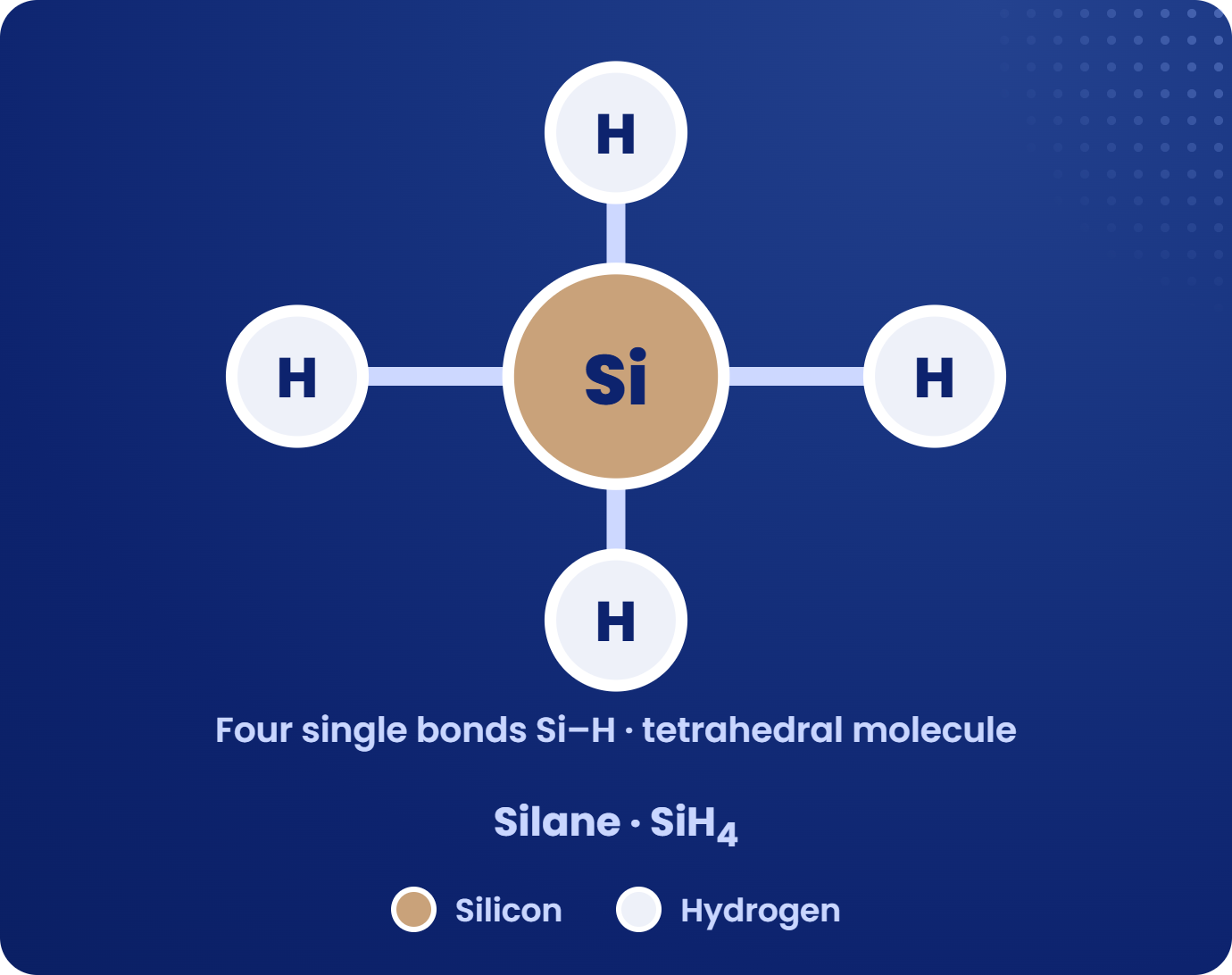
Silane, also known as monosilane or silicon tetrahydride, is used mainly in the manufacture of semiconductors, displays and photovoltaic cells. It serves notably as a silicon source for chemical vapour deposition.
At room temperature, it is a colourless, extremely flammable gas that may ignite spontaneously on contact with air.
1Main properties
These values apply to pure silane. The characteristics of commercial mixtures depend notably on the silane concentration and the dilution gas.
2What are the hazards?
Silane presents a major fire and explosion hazard. It may ignite spontaneously on contact with air, without an external flame or spark.
It reacts violently with oxidising agents. When heated, it may decompose into silicon and hydrogen, creating an additional fire and explosion hazard.
The international chemical safety card describes possible irritation of the eyes, skin and respiratory tract. Inhalation may cause coughing, headaches, nausea and a sore throat. Contact with the liquefied substance may cause frostbite.
3What occupational exposure limits apply?
Air Liquide’s Gas Encyclopedia reports the following value for France:
| Reference period | ppm | mg/m³ |
|---|---|---|
| 8-hour average | 5 | 7 |
| Short-term | Not specified in this source | Not specified in this source |
The legal status and original French text underlying this value were not confirmed in a primary regulatory source consulted for this factsheet. It must therefore not be presented here as a verified French regulatory occupational exposure limit. The ICSC also lists a TLV-TWA of 5 ppm, which is a separate reference.
These values do not, on their own, constitute gas detector alarm settings.
4How can risks be prevented?
Prevention relies on closed installations, suitable ventilation and equipment designed for the explosive atmosphere hazard. Leak control is essential because the gas may ignite spontaneously.
Materials and accessories must be validated for the actual conditions of use. General compatibility data do not replace this assessment.
In the event of a leak, evacuate the area and call in specialist personnel. Interventions in a hazardous atmosphere require suitable protection, including self-contained breathing apparatus.
Sources: INRS, CarAtex database, “Silicon tetrahydride”, April 2018, in French; ILO/WHO, International Chemical Safety Card No. 0564, “Silane”, July 1997, in English; Air Liquide, Gas Encyclopedia, “Silane”, in French.