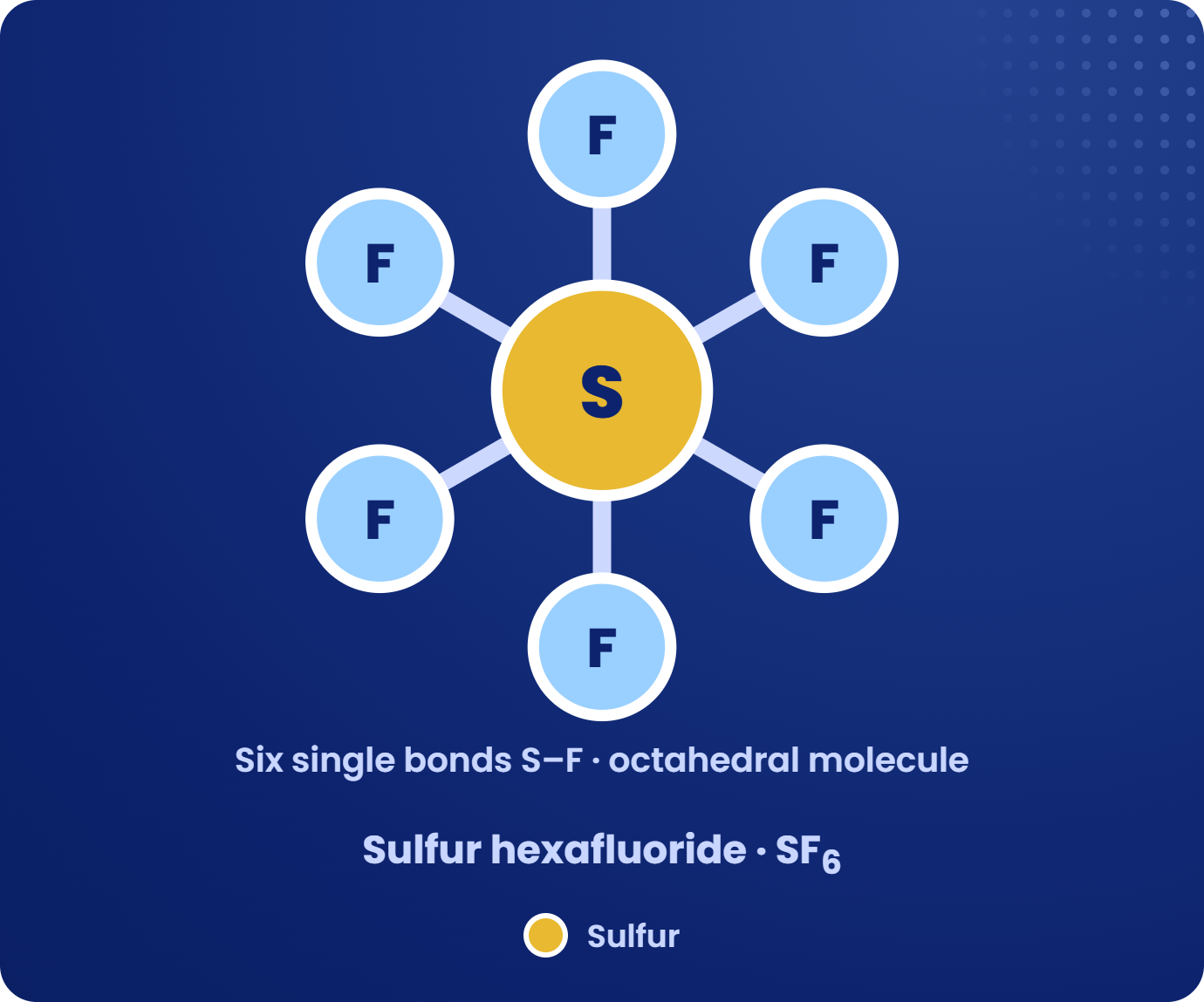
Sulfur hexafluoride, or SF₆, is used notably as an insulating gas in certain high-voltage electrical equipment and in semiconductor manufacturing. It also serves as a tracer gas for studying ventilation systems.
At room temperature, it is a colourless, odourless gas approximately five times heavier than air. It is practically insoluble in water and highly chemically stable under ordinary conditions.
1Main properties
At atmospheric pressure, solid SF₆ changes directly into a gas: −63.8 °C is a sublimation temperature, not a boiling point.
2What are the hazards?
SF₆ is non-combustible, but a leak can create a hazardous atmosphere. Being heavier than air, it can accumulate in low-lying areas and poorly ventilated spaces, reduce the oxygen concentration and cause potentially fatal asphyxiation. Its lack of odour means this accumulation cannot be detected by smell.
Contact with the liquefied substance can cause cold burns.
An electrical arc or very high temperature can cause SF₆ to form toxic and corrosive decomposition products, including compounds that may generate hydrogen fluoride on contact with moisture. The hazards of decomposed gas must therefore be distinguished from those of pure SF₆.
3What occupational exposure limits apply?
The INRS factsheet dated October 2019 reports the following indicative occupational exposure limit established in France in 1987:
| Reference period | ppm | mg/m³ |
|---|---|---|
| 8-hour average | 1,000 | 6,000 |
| Short-term | Not specified in this factsheet | Not specified in this factsheet |
This value does not, on its own, constitute a gas detector alarm setting. It does not replace assessment of oxygen deficiency or any decomposition products present.
4How can risks be prevented?
Prevention relies on controlling leaks and providing suitable ventilation. Depending on the risk assessment, a fixed or portable SF₆ detector can complement preventive measures.
Containers must be stored upright and secured against falling, in a cool, ventilated area, protected from heat and in accordance with the supplier’s instructions.
Personal protective equipment must account for the physical state of the substance and the possible presence of decomposition products.
In the event of a leak, evacuate the area and follow emergency procedures. Only trained personnel with suitable protective equipment should intervene. Self-contained breathing apparatus must be available for emergency response.
Source: INRS, Toxicological Factsheet No. 102, “Sulfur hexafluoride”, October 2019 edition, in French.