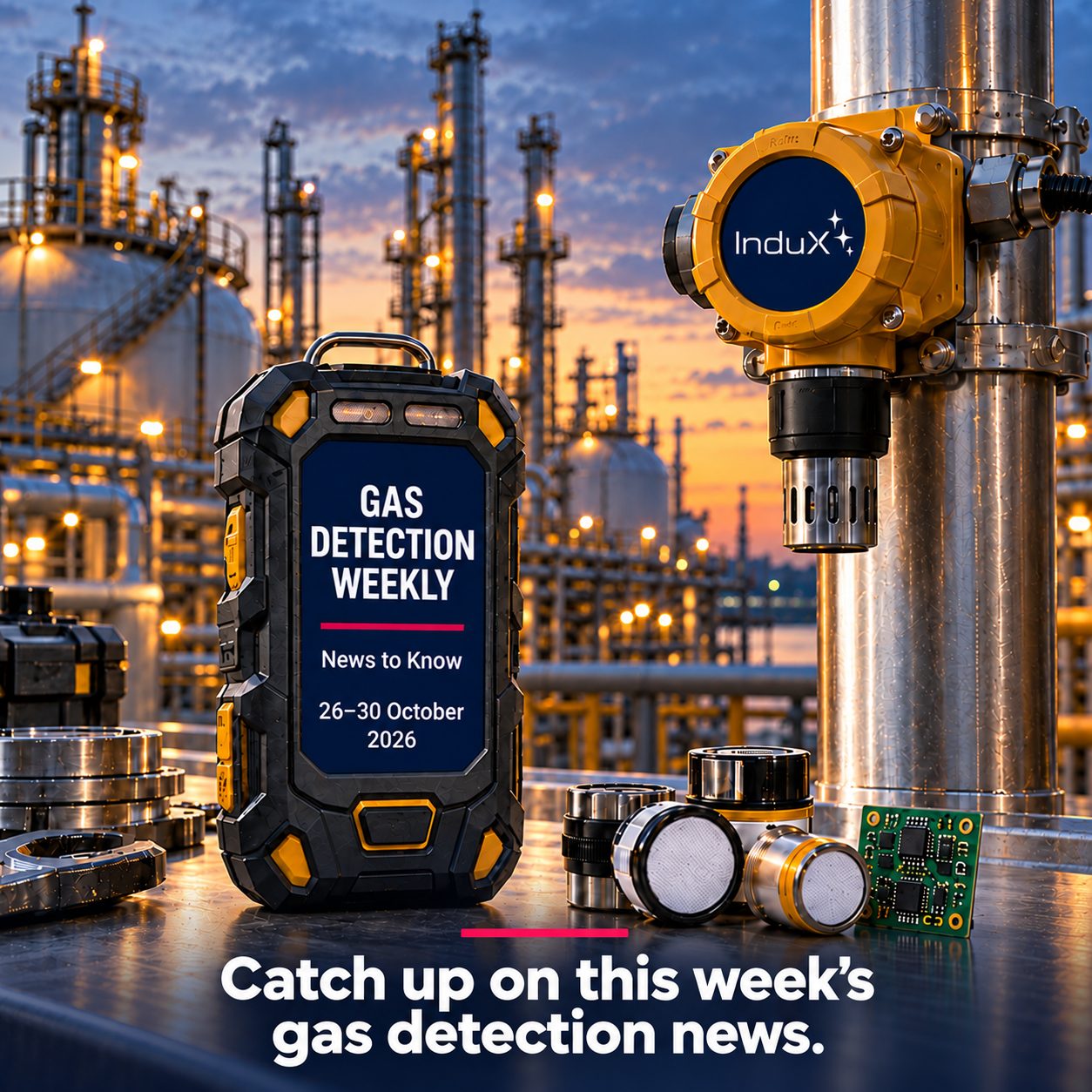
Gas Detection: The Week the Industry Won Awards and Faced Scrutiny
From 26 to 30 October 2026, the gas detection sector experienced five days of contrasts. Honeywell Technologies won ten international design awards for its detectors. MSA Safety secured a contract worth up to $10.6 million with a major electricity provider in the northeastern United States. At the same time, The Examination revealed that a Texas operator had continued allowing hydrogen sulfide to leak after a couple died at its facility. Technology is advancing. Accidents are not declining.
Fatalities, a Leak and Seven Years Without an Inspection
The week's most troubling investigation comes from the Permian Basin. According to The Examination, Aghorn continued allowing H2S to escape at its oilfield facility in Odessa, Texas, after a couple died there. At concentrations above a few hundred ppm, hydrogen sulfide can kill within a few breaths. It provides no reliable warning: at high concentrations, it disables the sense of smell.
Daily Kos reports a second Texas case. A chemical leak killed four people at a plant whose last workplace safety inspection had taken place seven years earlier. OSHA also cited Aspen Aerogels for "willful" violations following an explosion that injured eleven people, according to The Business Journals.
Three cases, one common finding. None concerns the absence of sensors. All concern what happens next: inspection, maintenance and action on alarms.
Brussels and Watertown: Cities Are Exposed Too
Gas hazards are not confined to refineries. In Brussels, the Kanal construction site was evacuated after a gas smell was reported, according to La Libre. A few days later, DHnet reported that a leak on Quai de Willebroeck had been sealed, with work continuing. In Watertown, an entire neighbourhood was evacuated after a domestic gas leak reached the lower explosive limit, Dakota News Now reports.
As the heating season begins, US utilities have launched their prevention campaigns. Piedmont Natural Gas is reminding customers how to recognise a natural gas leak, according to the Duke Energy News Center and WWAY News. UGI issued a carbon monoxide warning, reported by BCTV. SafeWork NSW published its own warning in Australia.
Hydrogen Drives Market Demand
On the business side, hydrogen is shaping demand. MSA Safety announced an ALTAIR io 6 contract with a major electricity provider in the northeastern United States. Pennsylvania Business Report and The Business Journals put the deal's potential value at $10.6 million. Occupational Health & Safety details the selected solution: cellular-connected detectors to protect lone workers.
IndexBox published a series of market studies this week looking ahead to 2035. They converge on the same value chain: electrochemical hydrogen sensors, catalytic filaments, pellistors, sample-draw detectors, modems, hydrogen sulfide probes and control panels. The firm names Honeywell International, MSA Safety, Industrial Scientific, RKI Instruments, GfG Instrumentation and Drägerwerk among the representative companies.
Robots Enter Explosive Atmospheres
The week's innovation is not a sensor. It is the platform carrying it. Inspenet reports that deliveries of ANYMAL X have begun: an ATEX- and IECEx-certified quadruped robot designed to inspect hazardous areas in place of a human operator.
Other announcements follow the same early-detection logic. The International Fire & Safety Journal reports that the Kentec K-Detect-iON provided a warning fourteen minutes before thermal runaway during a stationary battery fire test. Teledyne FLIR obtained the first UL 2684 certification for thermal imaging fire detection. Siemens made its Sitrans MS200 multisensor available for use in hazardous areas, according to impeller.net. BinMaster presented ATEX/IECEx-certified vibrating probes in Industrial Equipment News. Nikkiso launched a pump for hydrogen refuelling stations.
A Practical Example in the United Kingdom
Envirotec Magazine describes the week's only documented deployment. A British biogas facility equipped its teams with Blackline Safety G8 portable detectors connected to Blackline Live software. Gas detection, lone-worker protection and communication are handled through a single device.
Two Regulators, Two Directions
California enacted pioneering hydrogen pipeline safety legislation, The Santa Barbara Independent reports. At the federal level, the direction is different: The Guardian reports Democratic lawmakers' criticism of OSHA's plans to ease respiratory protection requirements.
In Europe, uncertainty is weighing on the sector. Siemens Energy warns that unclear European green hydrogen policy could freeze investment decisions and weaken electrolyser suppliers, according to Fuel Cells Works. Enagás is calling for a German-style financing model to secure its 2,875-kilometre Spanish network. The EU has launched the T-MED platform, backed by guarantees of up to €4.5 billion.
The Next Frontier: Worker Data
EHSLeaders published an article on governing data collected by wearable devices and connected safety systems, citing NIOSH guidelines. Canadian Occupational Safety published an opinion piece on real-time exposure monitoring. The question is no longer whether measurements are taken, but who retains them, for how long and for what purpose.
That is the week's central lesson. A connected detector creates a record. That record protects the worker when it triggers action. It becomes evidence against the operator when it shows that nobody acted.